おすすめの Google 拡張機能です!新しい言葉を勉強しましょう!
Here are the recommended Chrome extensions! Let’s learn new words here!
ポッドキャストプラットフォーム|Platforms of Podcast
こちらの記事は、配信中のポッドキャストのスクリプトです。
ぜひ、ポッドキャストを聞きながら読んでください。
 えみ先生
もう聞いた人は、クイズをチェックしましょう!
ちょっとクイズ!|CHOTTO Quiz!
ポッドキャストを聞いた人は、ちょっとクイズを解いてみましょう。
むずかしいときは、下のスクリプトを読んで、もう一度クイズをチェックしてみてください。
【えいご】English Translation
Answer these quiz questions if you’ve listened to a new episode of my podcast.
If it was difficult, read the transcript below and try again.
❓ お盆は 毎年 いつですか?|When is Obon every year?
8月13日から16日までです。
It is from August 13th to 16th.
❓ 「文通」は、何をすることですか?|What do people do when they do “buntsū” (letter exchange)?
手紙を交換することです。
It means exchanging letters.????
❓えみ先生は、手紙を書くとき、いつも何を入れますか?|What does Emi-sensei always put in a letter when she writes one?
シールを入れます。????????????
Emi-sensei puts stickers in the letter.
ポッドキャストのスクリプト|Transcript of Podcast
シーズン2 エピソード2「文通????」
このポッドキャストは、初中級(Pre-Intermediate)レベルです。
おはようございます。こんにちは。こんばんは。
日本語の先生、エミです。
今日も、ゆっくり やさしい日本語で話します。
ウェブサイトにスクリプトもあります。
チェックしながら 聞いてください。
【えいご】English Translation
Good morning. Hello. Good afternoon.
I am a Japanese teacher, Emi.
Today, I’m also going to speak slowly in easy Japanese.
There is also a script on my website, so please listen while checking it.
日本は お盆休みが終わりました。
みなさん、「お盆」何かわかりますか?
お盆は、日本の 8月のイベントです。
夏のイベントです。
毎年 8月13日から16日までがお盆です。
【えいご】English Translation
The Obon holiday in Japan is over.
Do you know what “Obon” is?
Obon is an event in Japan in August.
It is a summer event.
Every year, Obon is from August 13th to 16th.
お盆のときに 亡くなった人のことを考えます。
「亡くなる」は、「死ぬ」と同じ意味です。
おばあちゃんや おじいちゃん、亡くなった家族のことを 考える日です。
【えいご】English Translation
During Obon, we think about people who have passed away.
“亡くなる” means the same thing as “死ぬ,” which means “to die.”
It is a time to think about grandparents and other family members who have passed away.
メキシコの ディア・デ・ムルートス(Dia de Murtos)と似ています。
メキシコのイベントは、日本語で「死者の日」と言います。
「死者」は亡くなった人、Dead people
「日」は Day ですね。
The Day of Deadです。
【えいご】English Translation
It is similar to Mexico’s Día de Muertos.
In Japanese, this Mexican event is called “Shisha no Hi.”
“死者” means people who have died, or “dead people.”
“日” means “day.”
So, it means “The Day of the Dead.”
お盆のときは たくさんの会社が休みになります。
私の夫も 仕事が休みでした。
だから私もレッスンを休んでいました。
仕事を休んで、夫の家族の家に行きました。
お盆のとき、日本人は家族の家に帰ってゆっくりします。
でも、旅行をする人もいます。
私たちは家族の家に帰りました。
【えいご】English Translation
During Obon, many companies are closed.
My husband also had time off from work.
So, I also took a break from my lessons.
I took time off work and went to my husband’s family’s home.
During Obon, Japanese people go back to their family homes and relax.
But some people also travel.
We went back to our family’s home.
みなさんは夏休みがありますか?
今月、8月 どこかに行きましたか?
夏のアクティビティ、マリンスポーツしましたか?
ぜひ教えてください。
【えいご】English Translation
Do you have a summer vacation?
Did you go anywhere this month, in August?
Did you do any summer activities or water sports?
Please tell me.
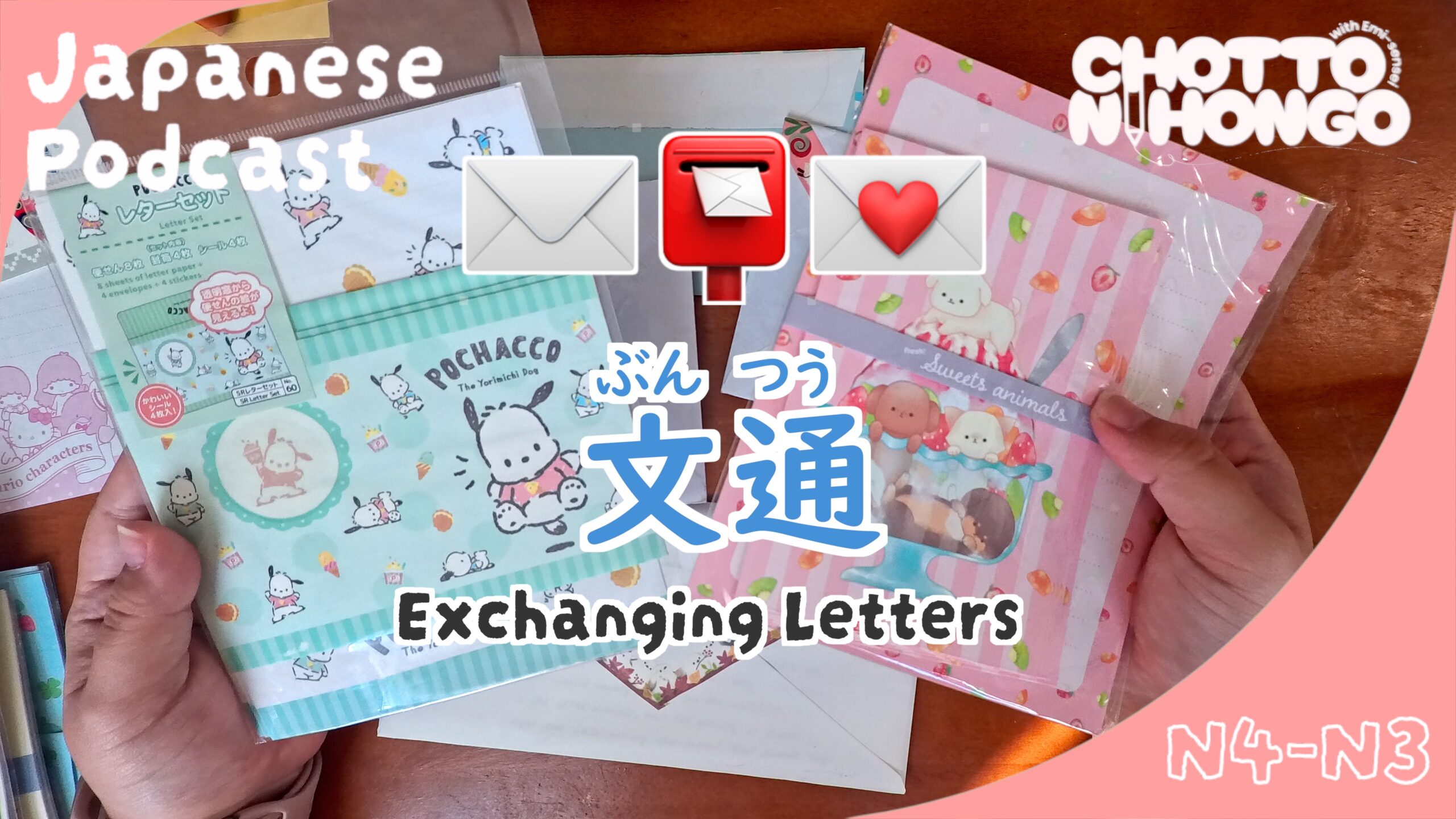
今日のトピックは 文通です。
「文通」なんですか?
わかりますか?
ここに ヒントがあります。
YouTubeで動画(ビデオ)を見ている人は わかるかもしれません。
ヒントは「手紙」です。「手紙」
手紙は 英語でLettersですね。Letter
【えいご】English Translation
Today’s topic is “buntsū.”
What is “buntsū”?
Do you know?
Here’s a hint.
If you are watching the video on YouTube, you might know.
The hint is “tegami,” which means “letter.”
In English, “手紙” is “letter.”
「文通」は、手紙を交換することです。
交換は Exchangeです。
手紙を交換します。
Exchanging Letters「文通」です。
今日は文通について話します。
【えいご】English Translation
“文通” means exchanging letters.
“交換” means “exchange.”
We exchange letters.
So, “文通” means “exchanging letters.”
Today, I’m going to talk about exchanging letters.
まずは、今日の新しい言葉を みなさんに教えます。
「手紙」
手紙はメッセージを書いた紙です。Paperです。
「手紙」
【えいご】English Translation
First, I’ll teach you some new words for today.
“tegami”
A letter is a piece of paper with a message written on it.
It is “tegami.”
そして「文通」
文通は、手紙を交換します。
Exchanging lettersです。
【えいご】English Translation
And “buntsuu.”
“文通” means exchanging letters.
It is “exchanging letters.”
そして、「ペンパル」
ペンパル、英語と同じですね。
でも、日本語で「文通友だち」と言うこともできます。
「ペンパル」
私は ペンパルがいます。
【えいご】English Translation
And “penparu.”
“ペンパル” is the same as the English word “pen pal,” right?
But in Japanese, you can also say “buntsuu tomodachi,” which means a friend you exchange letters with.
“Pen pal.”
I have a pen pal.
あと、「レターセット」
レターセットはEnvelopeとPaperのセットです。
【えいご】English Translation
And “retaa setto.”
A letter set is a set with an envelope and paper.
そして次は「封筒」
封筒はEnvelopeです。
【えいご】English Translation
And next is “fuutou.”
“fuutou” means “envelope.”
そして、封筒といっしょにPaperも使えますね。
Paperは日本語で「便箋」と言います。
メッセージがかけるPaper、紙のことを 便箋と言います。
「便箋」
便箋と封筒で「レターセット」です。
【えいご】English Translation
And you use paper together with an envelope, right?
In Japanese, “paper” is called “便箋.”
Paper that you can write a message on is called “便箋.”
“binsen.”
“binsen” and “fuutou” together make a “レターセット,” or letter set.
そして次は「文房具」
文房具、何かわかりますか?
文房具は ペンとか、
ハサミ…、ハサミとか
カッターも文房具です。
テープも文房具です。
Stationeryです。「文房具」
【えいご】English Translation
And next is “bunbougu.”
Do you know what “bunbougu” means?
“Bunbougu” includes things like pens,
scissors… scissors,
and box cutters are also “Bunbougu”.
Tape is also “Bunbougu”.
It means “stationery.” “Bunbougu”
あとは 私が大好きな「シール」です。「シール」
シールは英語でStickerですけど、日本語では大きいものはステッカーと言うことができます。
でも、日本語はシールという言葉をよく使います。
【えいご】English Translation
And then there is “シール,” which I love. “シール.”
“シール” is “sticker” in English, but in Japanese, you can use “ステッカー” for bigger ones.
But in Japanese, we often use the word “シール.”
あと、みなさん手紙を送るときに Stamp使いますね。
Stampは日本語で「切手」と言います。「切手」
手紙を送るときに Stamp、切手をはります。
切手を はって送ります。
【えいご】English Translation
Also, you use a stamp when you send a letter, right?
“Stamp” is “切手” in Japanese. “切手.”
When you send a letter, you put a stamp on it.
You put a stamp on it and send it.
そして、日本では この手紙を「郵便局」に持っていきます。
郵便局に行って 手紙を送ります。
「郵便局(Post office)」です。
【えいご】English Translation
And in Japan, you take this letter to the post office.
You go to the post office and send the letter.
“yuubin-kyoku,” = “post office.”
はい、10の新しい言葉をチェックしました。
このエピソードで使うので、よく聞いてくださいね。
そして、今日の文法もチェックしましょう。
【えいご】English Translation
Okay, we checked 10 new words.
I’ll use them in this episode, so please listen carefully.
And let’s check today’s grammar, too.
今日の文法は、
「V-たら うれしいです。」
「V-たら」の前は、可能形の過去形(Potential Past-tense)を使います。
【えいご】English Translation
Today’s grammar is:
“I would be happy if I could [Verb].”
Before “V-ta ra,” we use the past tense of the potential form.
たとえば、
「行けた」:to be able to GO, was able to GO
たとえば、
ディズニーランドに行けたら うれしいです。
【えいご】English Translation
For example,
“iketa” means “to be able to go” or “was able to go.”
For example,
“I would be happy if I could go to Disneyland.”
あと、
手紙をもらえたら うれしいです。
手紙をもらえたら うれしいです。
この「V-たら うれしいです」が使えるように
いっしょに練習しましょう。
【えいご】English Translation
Also,
“I would be happy if I could receive a letter.”
Let’s practice together so that you can use “V-tara ureshii desu.”
みなさんは文通をしたことがありますか?
子供のとき、友達に手紙をあげましたか?
手紙を もらいましたか?
私は子供のとき、よく友達に手紙を書いていました。
ときどき、「週末 遊ぼうね」と書いたり、好きな人のことを書いたりしました。
【えいご】English Translation
Have you ever exchanged letters with someone?
When you were a child, did you give letters to your friends?
Did you receive letters?
When I was a child, I often wrote letters to my friends.
Sometimes, I wrote things like, “Let’s hang out this weekend,” or I wrote about someone I liked.
でも、大人になったら あまり手紙を書きませんよね。
みなさんは書きますか?
私は大人になってからは、夫の誕生日や 友だちの誕生日のときだけ手紙を書きます。
とくべつなときだけです。
ときどき、手紙をもらえたら うれしいですよね。
私は うれしいです。
手紙をもらえたら うれしくなります。
【えいご】English Translation
But when you become an adult, you don’t write many letters anymore, right?
Do you?
Since I became an adult, I only write letters for my husband’s birthday or my friends’ birthdays.
Only on special occasions.
Sometimes, you would be happy if you received a letter, right?
I would be happy.
Receiving a letter would make me happy.
だから、去年、私は文通をする友だちが ほしくなりました。
文通をする友だち=ペンパルですね。
ペンパルが ほしくなりました。
ぺンパルが ほしくなったので、Global Penfriendsというウェブサイトを使って ペンパルを探しました。
【えいご】English Translation
So, last year, I wanted to have friends to exchange letters with.
A friend to exchange letters with is a pen pal, right?
I wanted to have pen pals.
Because I wanted pen pals, I used a website called Global Penfriends to look for one.
でも、最近 ペンパルに手紙を送っていません。
この手紙も 私のペンパルからもらいました。
でも、まだ読んでいません。
これから読みます。
まだ この手紙の返事(Reply)を書いていませんから、今日は 私のペンパルに手紙の返事(Reply)を書こうと思います。
【えいご】English Translation
But recently, I haven’t sent a letter to my pen pal.
I also received this letter from my pen pal.
But I haven’t read it yet.
I’m going to read it now.
I haven’t written a reply to this letter yet, so today I’m going to write a reply to my pen pal.
私は手紙を書くとき、いつもシールを いっしょに入れます。
このファイルが 私のシールブックです。
でも、ちょっと たくさん入っています。
そう、これが私のシールブックなんですけど、ちょっと汚いです。
こんな感じで、私は シールはよくダイソーで買います。
100円ショップで シールをたくさん買います。
【えいご】English Translation
When I write a letter, I always put stickers in it.
This file is my sticker book.
But there are quite a lot of stickers in it.
Yes, this is my sticker book, but it’s a little messy.
I often buy stickers at Daiso like this.
I buy lots of stickers at the 100-yen shop.
でも、このハリネズミ(Hedgehog)のシールは 私のペンパルからもらいました。
ダイソーには かわいいシールがたくさんありますから、ついつい買ってしまいます。
はい、たくさんシールがありますね。
でも、ダイソーじゃないシールもあります。
これ…、これはちょっと おもしろいレアなシールです。
【えいご】English Translation
But I got this hedgehog sticker from my pen pal.
DAISO has lots of cute stickers, so I end up buying them without thinking.
There are a lot of stickers, aren’t there?
But I also have stickers that aren’t from Daiso.
This one… this is a little interesting and rare sticker.
去年、日本の大阪でエキスポ、
日本語で「万博(Expo)」がありました。
そのエキスポのキャラクターのシールを買いました。
このキャラクターの名前は ミャクミャクと言います。
赤と青の色のキャラクターです。
ちょっと おもしろい形、おもしろいシェイプのキャラクターです。
【えいご】English Translation
Last year, there was an Expo in Osaka, Japan.
In Japanese, it is called “万博.”
I bought a sticker of the character from that Expo.
This character’s name is Myaku-Myaku.
It is a red and blue character.
It has a slightly interesting shape.
そして、このシールには大阪弁、関西弁が書いてあります。
ここに「まいど」と書いてあります。
「まいど」は「ありがとう」と似てるかなと思います。
そうですね、「まいど」は「ありがとう」の意味もあります。
あと、ちょっと「こんにちは」みたいな意味もあります。
はい、これはちょっとレアな おもしろいシールです。
【えいご】English Translation
And this sticker has Osaka dialect, or Kansai dialect, written on it.
It says “まいど” here.
I think “まいど” is similar to “ありがとう,” or “thank you.”
Yes, “まいど” can also mean “thank you.”
It can also have a meaning a little like “hello.”
So, this is a slightly rare and interesting sticker.
あと、私はカービィが好きですから、このカービィのシールもあります。
そして、最近、このキャラクター、カエルの…カエルのキャラクター?
エイリアン、宇宙人のキャラクターなんですけど、ケロロ軍曹と言います。
最近ケロロ軍曹が好きなので、このシールも買いました。
はい。だから けっこう たくさんシールがあります。
そして、手紙を送るときに 封筒の中にシールを入れて送ります。
【えいご】English Translation
Also, I like Kirby, so I have this Kirby sticker, too.
And recently, this character… a frog… a frog character?
It’s actually an alien character, and it’s called Keroro Gunso.
I’ve recently started liking Keroro Gunso, so I bought this sticker, too.
So, I have quite a lot of stickers.
And when I send a letter, I put a sticker inside the envelope and send it.
私はポストカードをもらっても うれしいです。
ポストカードは 日本語もポストカードと言います。
あと、日本語の言葉で「はがき」とも言います。
でも、デザインがあるときはポストカードと言うことが多いです。
私は台湾に行ったとき、台湾のポストカードを買いました。
富士山のポストカードもあります。
2年前、2024年に夫と一緒に富士山に登って、この富士山のポストカードを買いました。
はい、たくさんポストカードがあります。
【えいご】English Translation
I would also be happy to receive a postcard.
In Japanese, we also say “posutokādo” for postcard.
You can also say “hagaki” in Japanese.
But when it has a design on it, we often call it a “posutokādo.”
When I went to Taiwan, I bought postcards from Taiwan.
I also have postcards of Mt. Fuji.
Two years ago, in 2024, I climbed Mt. Fuji with my husband and bought this Mt. Fuji postcard.
So, I have a lot of postcards.
じゃあ、これから 私のペンパルからもらった手紙を読んで、手紙の返事(Reply)を書きたいと思います。
返事を書いて、郵便局に行って送ります。
手紙を送ります。
【えいご】English Translation
Okay, now I’m going to read the letter I received from my pen pals and write a reply to the letter.
I’ll write the reply, then go to the post office and send it.
I’ll send the letter.
じゃあ、今日の文法、復習しましょう。
Reviewしましょう。
今日の文法は、
「V-たら うれしいです。」
この文法でした。
【えいご】English Translation
Okay, let’s review today’s grammar.
Let’s review.
Today’s grammar was;
“I would be happy if I could [Verb].”
私は、手紙を もらえたら うれしいです。
そして
手紙の中にシール、シールがあったら もっと うれしいです。
シールが あったら うれしいです。
【えいご】English Translation
“I would be happy if I could receive a letter.”
And,
“I would be even happier if there were stickers inside the letter.”
“I would be happy if there were stickers.”
あと、
かわいいレターセットが 見つけられたら うれしいです。
かわいいレターセットがあったらいつも買ってしまいます。
【えいご】English Translation
And,
“I would be happy if I could find a cute letter set.”
Whenever I find a cute letter set, I always end up buying it.
みなさんは何ができたら うれしいですか?
手紙もらえたら うれしいですか?
レターセット、かわいいレターセットが見つけられたら嬉しいですか?
かわいいデザインのメモ、かわいいデザインの紙を 見つけられたら うれしいですか?
「V-たら うれしいです。」
使ってみてください。
【えいご】English Translation
What would make you happy if you could do it?
Would you be happy if you could receive a letter?
Would you be happy if you could find a cute letter set?
Would you be happy if you could find a memo pad or paper with a cute design?
“V-tara ureshii desu.”
Please try using it.
みなさんも 手紙 書いてみてください。
友達に書いたり、家族に書いたり、好きな人/パートナーに書いたりしてみてください。
はい。
ポストカードもいいです。
封筒…、手紙もいいですね。
みなさんは誰に手紙を書きたいですか?
ペンパルいますか?
文通友だち いますか?
ぜひ教えてください。
【えいご】English Translation
You should all try writing a letter, too.
Try writing one to a friend, your family, or someone you like or your partner.
Postcards are also good.
An envelope… a letter is good, too.
Who would you like to write a letter to?
Do you have a pen pal?
Do you have a friend you exchange letters with?
Please tell me.
今日のポッドキャストのスクリプトは、私のウェブサイトにあります。
ウェブサイトは、 en-nihongo.com です。
よかったら、ポッドキャストの感想や 質問の答えを コメントで教えてください!
また来週のポッドキャストで会いましょう。
じゃあね~!
【えいご】English Translation
A transcript for today’s podcast is on my website.
The website is en-nihongo.com .
I’d be very happy if you could share your thoughts/impressions in this episode!
I’ll see you in the next episode.
Jaa ne-!


 Google
コメント|Comment